Pytes Pi LV1 Stackable LFP Battery: Compact Residential Energy Storage Built for Flexible Expansion
Discover the Pytes Pi LV1 stackable LFP battery, a compact plug-and-play residential energy storage solution with expandable capacity up to 30.72kWh.
Residential energy storage systems are shifting toward modular designs that are easier to install, easier to expand, and better suited to real household energy usage. Fixed-capacity battery systems often force homeowners to oversize their installations at the beginning, even when current electricity demand is relatively low.
The Pytes Pi LV1 stackable LFP battery takes a different approach.
Its vertical stackable structure allows homeowners to start with a smaller battery configuration and expand capacity later by adding additional modules. The system supports expansion up to 30.72kWh without replacing the original installation. For residential solar projects where available space is limited, this design offers a more practical deployment method than large rack-mounted battery systems.
The combination of compact structure, plug-and-play installation, and lithium iron phosphate safety makes the Pytes Pi LV1 suitable for residential solar storage, backup power, and off-grid energy applications.
What Is the Pytes Pi LV1 Stackable LFP Battery?
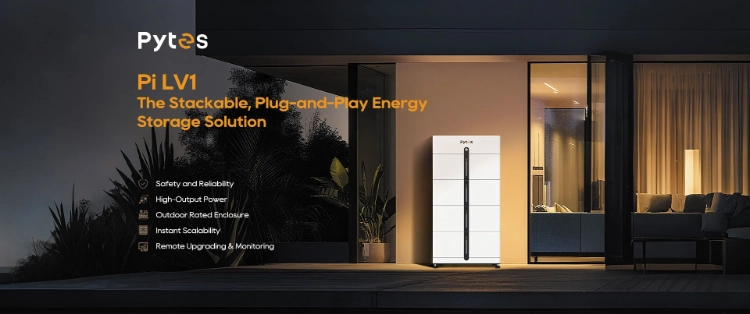
The Pytes Pi LV1 stackable LFP battery is a low-voltage residential energy storage system based on lithium iron phosphate (LFP) battery technology.
The system is designed around several core features:
- Stackable modular architecture
- Plug-and-play installation
- Compact footprint
- Expandable capacity up to 30.72kWh
- Outdoor-rated enclosure
- Remote monitoring and firmware upgrading
- High-output residential power support
Instead of using a traditional rack cabinet structure, the Pi LV1 integrates battery modules into a vertical stack. This reduces installation footprint while simplifying future capacity expansion.
For residential installers, fewer structural requirements generally mean faster deployment and simpler wiring management.
Stackable Battery Design Reduces Installation Constraints
Residential battery installation space is often limited. Large wall-mounted systems or rack-mounted battery cabinets can create problems in smaller homes, garages, or retrofit solar projects.
The Pytes Pi LV1 stackable LFP battery addresses this issue with a narrow vertical layout designed for compact residential environments.
Typical installation locations include:
- Residential garages
- Utility rooms
- Townhouses
- Small solar retrofit projects
- Vacation homes
- Off-grid cabins
Because battery modules stack directly together, installers do not need to allocate additional rack space or complex support structures.
The simplified physical layout also improves cable organization and creates a cleaner finished installation.
Plug-and-Play Installation Improves Deployment Efficiency
Installation complexity directly affects residential ESS project cost.
Many traditional residential battery systems require:
- Rack assembly
- Separate communication wiring
- Additional mounting hardware
- Multi-step commissioning
The Pytes Pi LV1 stackable LFP battery reduces installation workload through a plug-and-play modular structure.
Battery modules are designed for direct stacking and system integration, helping installers reduce deployment time while lowering the possibility of installation errors.
For solar installation companies managing multiple residential projects, reduced installation time improves labor efficiency and overall project turnover.
The simplified architecture also benefits homeowners by reducing future maintenance complexity.
Why LFP Battery Chemistry Is Widely Used in Residential ESS
The Pytes Pi LV1 stackable LFP battery uses lithium iron phosphate chemistry, commonly referred to as LFP.
LFP batteries have become increasingly common in residential energy storage because they combine long cycle life with strong thermal stability characteristics.
Compared with some other lithium battery chemistries, LFP technology typically provides:
- Longer operational lifespan
- Lower long-term degradation
- Improved thermal stability
- Higher safety margins under residential operating conditions
Residential ESS systems usually perform daily charge and discharge cycles alongside rooftop solar generation. Battery cycle durability therefore has a direct effect on long-term operating cost and system reliability.
For homeowners evaluating long-term residential storage investment, battery lifespan is often as important as initial purchase price.
Expandable Capacity up to 30.72kWh
One of the strongest advantages of the Pytes Pi LV1 stackable LFP battery is scalable capacity expansion.
Residential electricity demand rarely remains fixed over time. Energy consumption often increases because of:
- Electric vehicle charging
- Heat pump installation
- Additional household appliances
- Home office equipment
- Increased nighttime electricity usage
Instead of replacing the original ESS system, homeowners can expand the Pi LV1 by stacking additional battery modules.
This incremental expansion model reduces unnecessary upfront oversizing while allowing future flexibility.
Smaller initial systems may support basic backup loads and solar self-consumption, while larger configurations can support extended backup duration and higher residential energy demand.
Compact Structure Fits Modern Residential Environments
Large residential battery cabinets are not always practical in compact homes.
The Pytes Pi LV1 stackable LFP battery uses a vertical integrated structure that occupies less floor area than many conventional rack systems.
This matters in residential environments where installation space is limited or shared with other equipment.
The streamlined exterior appearance also fits more naturally into modern residential settings compared with industrial-style battery racks.
For homeowners concerned about installation aesthetics, compact stackable systems are often easier to accept visually.
Outdoor-Rated Enclosure Expands Installation Options
Not every residential project has suitable indoor battery space.
The outdoor-rated enclosure of the Pytes Pi LV1 stackable LFP battery allows deployment in protected exterior areas, including:
- Exterior utility spaces
- Covered patios
- Solar equipment zones
- Side-yard installations
This flexibility helps installers optimize site layout without relying entirely on indoor utility rooms.
Outdoor compatibility also improves deployment flexibility in retrofit projects where indoor space may already be occupied.
High-Output Power Support for Residential Loads
Residential electricity demand has increased significantly as homes become more electrified.
Modern residential ESS systems increasingly need to support:
- Air conditioning systems
- Heat pumps
- Kitchen appliances
- EV chargers
- Home office equipment
- Smart home electronics
The Pytes Pi LV1 stackable LFP battery is designed for high-output residential power applications, helping maintain stable operation during backup mode and peak demand conditions.
For households using battery storage during outages, stable high-load support becomes especially important.
Remote Monitoring and Firmware Upgrading
The system includes remote monitoring and firmware upgrade capability.
Users can monitor:
- Battery operating status
- Energy consumption
- System performance
- Operational conditions
Remote firmware updates simplify long-term maintenance while reducing the need for on-site servicing.
For installers and service providers, remote diagnostics can improve after-sales efficiency and shorten troubleshooting time.
Typical Residential Applications
The Pytes Pi LV1 stackable LFP battery supports multiple residential energy storage scenarios.
Residential Solar Energy Storage
Store excess daytime solar generation for nighttime household consumption.
Backup Power Systems
Maintain electricity supply during grid outages.
Off-Grid Residential Systems
Support remote homes, cabins, and independent energy systems.
EV Charging Support
Help balance household charging demand and reduce grid dependence.
Time-of-Use Optimization
Store electricity during lower-rate periods and discharge during peak pricing windows.
Why Demand for Stackable Residential ESS Systems Is Increasing
Several market trends are accelerating residential battery adoption:
- Rising electricity costs
- Increasing rooftop solar installations
- Growing EV ownership
- Higher demand for backup power
- Residential electrification
At the same time, homeowners increasingly prefer systems that can expand gradually instead of requiring large initial investment.
The Pytes Pi LV1 stackable LFP battery aligns closely with this market direction through its modular expansion design and compact residential form factor.
Pytes Pi LV1 Compared with Traditional Rack Battery Systems
Rack-mounted battery systems remain common in commercial and industrial ESS projects, but they are often oversized for residential environments.
Compared with traditional rack systems, stackable residential batteries offer several practical advantages:
- Smaller installation footprint
- Reduced installation complexity
- Easier capacity expansion
- Cleaner residential appearance
- Lower structural requirements
For most residential solar storage projects, these practical installation benefits matter more than industrial-scale capacity density.
Conclusion
The Pytes Pi LV1 stackable LFP battery focuses on practical residential ESS requirements rather than oversized system architecture.
Its stackable modular structure allows homeowners to expand storage capacity up to 30.72kWh without replacing the original system. Combined with plug-and-play installation, lithium iron phosphate safety, outdoor-rated protection, and remote monitoring capability, the system fits a wide range of residential solar and backup power applications.
For installers, the simplified deployment process improves installation efficiency. For homeowners, the modular expansion model reduces unnecessary upfront investment while preserving future flexibility.
As residential electricity demand continues to grow, scalable battery systems with compact installation footprints are becoming increasingly relevant in the home energy storage market.

-
<
Previous
-
>
Next