Pytes Pi LV1 Stackable Home Battery: The Complete Guide to Next-Generation Residential Energy Storage
The Pytes Pi LV1 stackable home battery represents a significant evolution in residential energy storage technology.
As global energy demand continues to rise and electricity prices fluctuate, homeowners are increasingly turning to advanced energy storage solutions to achieve energy independence, cost savings, and sustainability. Among the most innovative solutions in the residential energy storage sector is the Pytes Pi LV1 stackable home battery.
Designed for compact installation environments and scalable energy expansion, this system represents a new generation of plug-and-play lithium battery technology. Unlike traditional fixed-capacity battery systems, the Pi LV1 introduces a modular stacking architecture that allows users to expand storage capacity simply by adding additional battery units.
What Is Pytes Pi LV1 Stackable Home Battery?
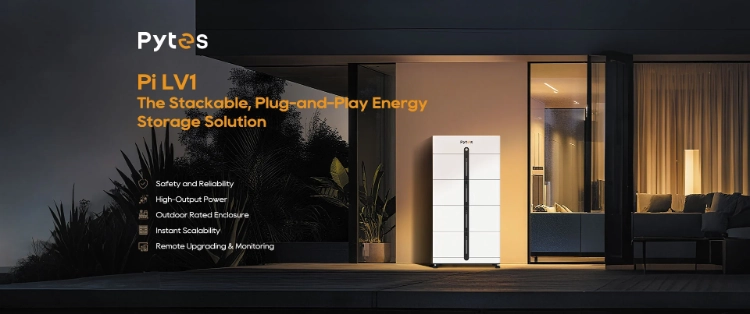
The Pytes Pi LV1 stackable home battery is a low-voltage residential energy storage system designed with a modular stacking architecture. Each battery module can operate independently or be combined vertically to increase total energy capacity.
The system is engineered to support:
- Residential solar energy storage
- Backup power supply
- Peak shaving and load shifting
- Energy self-consumption optimization
Core Concept: Stackable Energy Expansion
The defining feature of the Pi LV1 system is its stackable design. Instead of requiring complex wiring or external rack systems, users can simply stack battery modules vertically to expand capacity.
This plug-and-play approach significantly reduces:
- Installation time
- Wiring complexity
- System integration cost
At full configuration, the system can reach up to 30.72 kWh, making it suitable for both basic household backup and high-demand energy scenarios.
Product Design Philosophy: Compact, Modular, and Scalable
The Pytes Pi LV1 is built around three core engineering principles:
1. Compact Structural Design
The system is designed for environments where installation space is limited. Its vertical stacking architecture minimizes floor space requirements while maximizing energy density.
2. Modular Expansion
Each battery unit is a self-contained energy module. Users can start with a small configuration and gradually expand as energy demand increases.
3. Plug-and-Play Integration
The system is designed for simplified installation without complex configuration processes, making it suitable for both professional installers and residential users.
How Pytes Pi LV1 Stackable Home Battery Works
The operating principle of the system is based on intelligent energy storage and dispatch.
Step 1: Energy Input
Electricity is stored from:
- Solar photovoltaic systems
- Grid charging during off-peak hours
Step 2: Energy Storage
Energy is stored in lithium battery modules with optimized charge-discharge management controlled by BMS.
Step 3: Energy Output
Stored energy is released during:
- Peak electricity pricing periods
- Grid outages
- High household demand periods
Step 4: Smart Energy Optimization
The system dynamically balances:
- Load demand
- Battery state of charge (SOC)
- Energy efficiency
Installation Advantages of Pytes Pi LV1 Stackable Home Battery
1. Space-Saving Design
The vertical stacking structure significantly reduces installation footprint, making it ideal for:
- Apartments
- Villas
- Small utility rooms
2. Simple Installation Process
Compared to traditional rack-mounted systems, Pi LV1 reduces:
- Cable complexity
- Mounting hardware requirements
- Installation labor time
3. Flexible Configuration
Users can configure:
- Single-module system for basic backup
- Multi-module system for full household energy independence
Energy Capacity Scalability: Up to 30.72 kWh
One of the strongest advantages of the Pytes Pi LV1 system is its scalability.
Capacity Expansion Model:
- Start: Single module for essential backup
- Expansion: Add additional modules as demand grows
- Maximum configuration: Up to 30.72 kWh total capacity
This makes it suitable for:
- Daily residential energy storage
- Full-home backup systems
- Solar self-consumption optimization
Why Pytes Pi LV1 Is Ideal for Modern Energy Users
1. Adaptable to Growing Energy Needs
Users can start small and expand over time.
2. Reduced Installation Cost
Simplified design reduces labor and installation complexity.
3. High System Efficiency
Optimized lithium battery chemistry ensures high energy conversion efficiency.
4. Smart Energy Control
Real-time monitoring improves energy management decisions.
OEM and Manufacturing Perspective
From an engineering and manufacturing standpoint, the Pytes Pi LV1 stackable home battery represents advanced integration of:
1. Precision Battery Module Manufacturing
Each module requires:
- Cell consistency matching
- Voltage calibration
- Structural precision assembly
2. Advanced BMS Integration
The battery management system is central to safety and performance optimization.
3. Modular Mechanical Design
Stacking alignment requires high-precision structural engineering.
4. Quality Assurance Testing
Includes:
- Cycle life testing
- Thermal stability testing
- Load simulation testing
- Drop and vibration testing
Economic Value and ROI Analysis
Investing in a Pytes Pi LV1 system delivers long-term economic benefits:
1. Reduced Electricity Bills
By optimizing solar self-consumption and peak shaving.
2. Energy Independence
Reduces reliance on unstable grid pricing.
3. Long Lifecycle Value
Lithium battery systems offer long operational life with stable performance.
Conclusion
The Pytes Pi LV1 stackable home battery represents a significant evolution in residential energy storage technology. By combining modular design, intelligent BMS control, and plug-and-play installation, it delivers a flexible, scalable, and highly efficient solution for modern energy users.
As energy systems continue to shift toward decentralization and renewable integration, stackable battery architectures like the Pi LV1 will play a central role in enabling energy independence, cost optimization, and sustainable living.
For homeowners and installers alike, this system is not just a battery—it is a future-ready energy platform designed to grow with user needs over time.