Pytes Pi LV1 Stackable Home Battery: Compact Power That Grows with Your Home
Discover the Pytes Pi LV1 stackable home battery, a compact and easy-to-install energy storage solution with scalable backup capacity up to 30.72kWh.
Home energy storage needs can change as electricity consumption, solar capacity, and backup power requirements evolve. The Pytes Pi LV1 stackable home battery addresses this challenge with a compact, modular design that makes installation and capacity expansion straightforward. Designed especially for installations where space is limited, Pi LV1 allows homeowners to build a scalable energy storage system without unnecessarily complicating the installation.
Why the Pytes Pi LV1 Stackable Home Battery Fits Space-Constrained Homes
Residential battery installations often need to work around garages, utility rooms, exterior walls, and other areas where available space is limited. The physical design of the battery system can therefore be just as important as its storage capacity.
Compact Design for Limited Installation Space
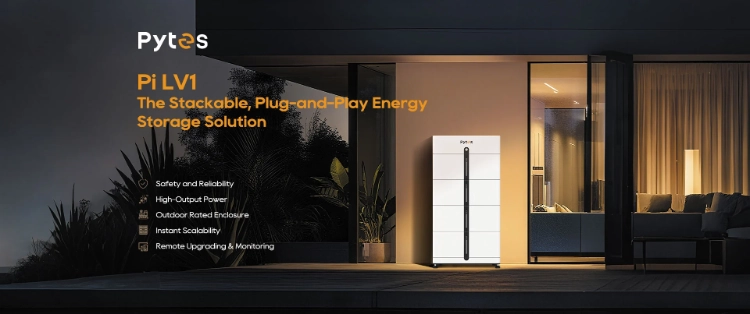
The Pytes Pi LV1 stackable home battery features a compact structure designed for environments where efficient use of installation space matters. Its vertically stackable configuration allows multiple battery modules to be arranged as one integrated system rather than requiring extensive wall or floor space for individually positioned units.
This approach can make Pi LV1 particularly practical for residential energy storage projects where homeowners want meaningful backup capacity while keeping the battery installation organized and space-efficient.
Stackable Architecture Simplifies Installation
Pi LV1 is designed around a straightforward stackable architecture. Battery modules can be stacked to create the required system configuration, reducing the complexity associated with arranging multiple separate battery enclosures.
The Pytes Pi LV1 stackable home battery is positioned as a plug-and-play energy storage solution, helping simplify system expansion and installation. A clean modular structure can also provide installers with a more organized approach when configuring residential storage systems.
Actual installation should always follow applicable electrical requirements, system specifications, and the manufacturer's installation instructions.
Designed for Indoor and Outdoor Flexibility
Home battery placement can vary considerably from one property to another. Some systems are installed inside garages or utility spaces, while others require an appropriate outdoor installation location.
The Pytes Pi LV1 stackable home battery features an outdoor-rated enclosure, expanding the possibilities for residential system planning. This flexibility can be particularly valuable where indoor installation space is restricted.
Final placement should still consider the specified environmental limits, required clearances, electrical connections, accessibility, and applicable local installation requirements.
How the Pytes Pi LV1 Stackable Home Battery Makes Energy Storage Scalable
Residential energy requirements are rarely identical. One homeowner may need storage primarily for essential backup loads, while another may want greater capacity to support a larger portion of household consumption. A modular battery system allows storage capacity to be configured around these different requirements.
Expandable Capacity up to 30.72kWh
One of the key advantages of the Pytes Pi LV1 stackable home battery is its scalability. Instead of requiring homeowners to commit immediately to a large fixed-capacity system, the modular design allows battery capacity to be expanded by stacking additional units.
The system can scale to a maximum backup energy capacity of 30.72kWh, providing flexibility for households with different energy storage requirements. This makes it possible to configure the battery system according to current needs while retaining a practical pathway for capacity expansion.
For residential projects, the appropriate capacity should be determined according to household energy consumption, required backup duration, critical loads, solar generation, and the overall inverter and energy system configuration.
High-Output Power for Residential Energy Needs
Capacity determines how much energy a battery can store, but power capability determines how effectively that energy can be delivered to household loads. Both factors need to be considered when designing a residential backup system.
The Pytes Pi LV1 stackable home battery is designed with high-output power as one of its core performance characteristics. This allows the battery platform to support demanding residential energy storage requirements when properly configured within a compatible system.
Actual backup performance will depend on the battery configuration, inverter capability, connected loads, and complete system design. Capacity and output power should therefore be evaluated together rather than treating kWh capacity as the only selection criterion.
Flexible Expansion as Energy Needs Change
A homeowner's energy requirements may increase after the initial installation. Additional electrical appliances, greater backup expectations, changes in household consumption, or expansion of a solar system can all influence future storage demand.
The modular architecture of the Pytes Pi LV1 stackable home battery provides greater flexibility to respond to these changes. Rather than replacing the entire battery system simply to obtain more storage capacity, the stackable concept creates a more adaptable foundation for residential energy storage.
This scalability can also help installers develop storage configurations for different customer requirements using the same battery platform.
How the Pytes Pi LV1 Stackable Home Battery Supports Smarter Home Energy
Modern home batteries are increasingly expected to provide more than energy storage alone. System monitoring, reliability, remote management, and integration with the wider residential energy system all influence the ownership experience.
Safety and Reliability for Home Energy Storage
Residential battery systems operate close to homes and valuable electrical equipment, making safety and reliability fundamental considerations. The Pytes Pi LV1 stackable home battery is designed with safety and reliability as core product priorities.
Battery performance should always be considered at the system level, including battery management, electrical protection, inverter compatibility, installation practices, and environmental conditions. Correct system configuration and professional installation remain essential for reliable long-term operation.
Remote Monitoring for Easier System Management
Visibility into battery operation can make residential energy storage easier to manage. Remote monitoring allows relevant system information to be accessed without requiring routine physical inspection of the battery.
The Pytes Pi LV1 stackable home battery supports remote upgrading and monitoring, providing a more convenient approach to system management. For installers and homeowners, connected functionality can help make the energy storage system more manageable throughout its operating life.
The specific monitoring functions available should be confirmed according to the final system configuration and supporting equipment.
A Practical Platform for Modern Home Energy Systems
A home battery should integrate effectively with the broader energy system rather than operate as an isolated component. Solar generation, inverter configuration, household loads, grid conditions, and backup requirements all need to work together.
With its compact footprint, modular capacity, high-output design, and remote management capabilities, the Pytes Pi LV1 stackable home battery provides a flexible platform for residential energy storage projects.
For installers and energy storage professionals, the stackable architecture also makes it possible to configure systems around different household requirements while maintaining a consistent battery platform.
Conclusion
The Pytes Pi LV1 stackable home battery combines compact installation, simple stacking, high-output capability, and scalable backup energy in a residential storage platform designed for flexibility. With capacity expandable up to 30.72kWh, it can adapt to different household energy requirements while making efficient use of limited installation space.
For homeowners and installers looking for a scalable home energy storage solution, Pi LV1 provides a practical foundation that can grow with changing energy needs.